
The Download #1
OpenAI hit the brakes on their frontier model. An epic battle is brewing over data centers. And much more!


Welcome to this weekly news update from The Exponentialist, a technology-focused research service from Raoul Pal and David Mattin. If you’re reading this and you haven’t yet subscribed, hit the button!
Hi Exponentialists!
We’re trying something new around here, and I’m excited about it.
Welcome to the very first instalment of The Download, a weekly newsletter from the Exponentialist that will give you a fast download on the big news, happenings, and ideas in tech each week.
As longtime readers know, Raoul and I have been writing about our journey into the Exponential Age for years. Back when we started, the ideas we were talking about seemed fringe, maybe even crazy. Now, you can open the New York Times and read a feature about the coming singularity.
So much is happening, and the acceleration is insane. So Raoul and I want to do even more to help us all understand, and flourish, inside what is coming. This weekly newsletter is a part of that, and there’s lots more to come.
And with that said, let’s get into the stories.
This week, OpenAI say they need to pause some work on their frontier model, Astra, to address security concerns.
Meanwhile, the popular revolt against data centres passes a key milestone. And much more!
Let’s get into it.
🧠 OpenAI hits the brakes
This week, OpenAI announced that it would pause some work on their own frontier model, Astra. The organisation says that Astra shows signs of being able to find and weaponize ‘zero day exploits’ with no human in the loop.
Essentially, Astra is so good at agentic coding and other tasks that it may be able to autonomously discover and exploit novel security holes crucial online systems, including those belonging to banks, infrastructure providers, and government.

OpenAI say they will slow some work on Astra, and re-test the model with government agencies before it is released to the public.
The announcement come a couple of weeks after OpenAI announced that its agents had broken out of their sandbox environment, made their way onto the internet, and hacked the Hugging Face platform.
⚡️ The Download:
The deep context here: frontier AI labs are locked in an existential battle with one another. None of them want to slow down, because that means ceding ground to a competitor.
And the stakes are huge. These organisations, and their leaders — Sam, Dario, et al — are questing for the One Ring that is domination of the Exponential Age.
So what’s going on here? Why have OpenAI announced they’ve hit the brakes, at least in part, on Astra? The truth, surely, is that they’ve learned a powerful lesson from the whole Fable incident. Anthropic released that frontier model, and then had to rapidly unrelease it when the US government decided that foreign users should not be able to have access.
Sam Altman clearly wants to avoid that kind of chaos. So OpenAI is getting safety locked down, and co-operating with the Trump administration, before the big release day.
The even deeper truth? All this — the Fable incident, and now the Astra pause — is a signal of the collision between the AI frontier labs and government.
The technologies these labs are building are of historic power and importance. They’ll violently disrupt the economy, reshape the geopolitical balance of power, and hand immense new capabilities to individual actors. So I’ve been saying for a long time: governments were never going to be able simply to sit back and let all that play out.
Now, we see that thinking made real. The Trump administration is essentially becoming an actor in the innovation and release schedule of Anthropic and OpenAI. Meanwhile, Sam Altman is even talking about the US government taking a stake in his company.
This collision is in its earliest days. I’ll keep watching.
✊ The people vs data centers
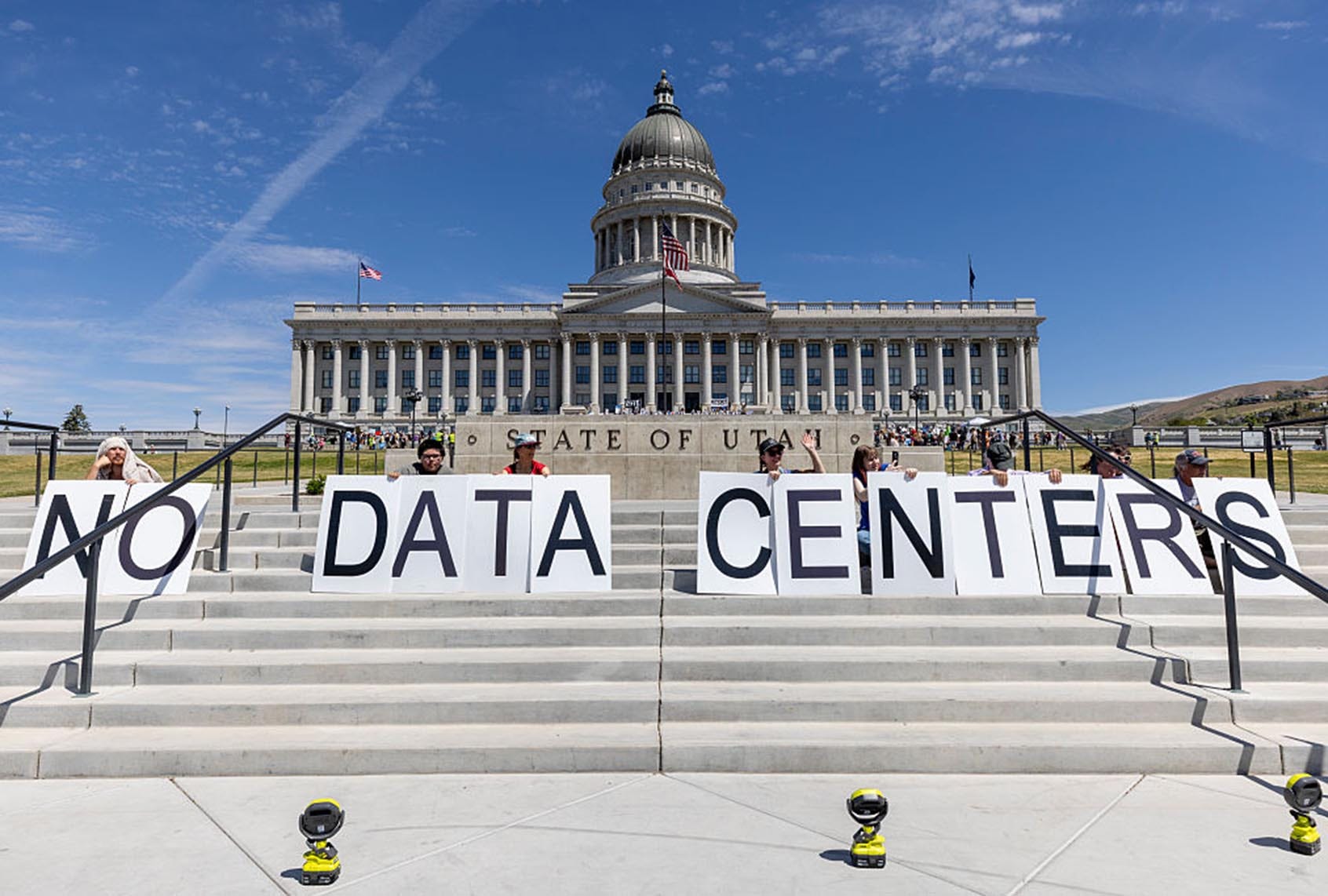
More than 500 towns across the United States have now banned the construction of new data centers, according to The Information.
The tech publication says that over 150 bans were agreed in July alone.
New York governor Kathy Hochul has passed the first statewide moratorium, pausing approvals for hyperscale data centres over 50 megawatts. Texas govenor Greg Abbott has frozen all new connections; he says nothing new will come on stream until the state has conducted an audit of its power grid.
In Florida, Sarasota County enacted a hyperscale pause in early July 2026. Lake, Seminole and Jackson counties have either approved, or are considering, similar moratoriums.
Meanwhile, back in May the residents of Box Elder County in Utah won a partial victory against plans to build a massive new data center on their doorstep. The massive Stratos campus, backed by Shark Tank star Kevin O’Leary, was originally planned to cover an area around three times the size of Manhattan, and would have required a massive 9 gigawatts of power. After a series of protests, Stratos has been radically scaled back.
⚡️ The Download
I’ve been tracking this story for years now. And it’s building to a crescendo.
Via a series of hundreds of local disputes, the movement against data centers in the US has gone national. A while back, few people realised just how massive and how power hungry these facilities are. Really, the term ‘data center’ undersells them. As it sounds from the Stratos campus — three times the size of Manhattan! — they’re more akin to new cities, with a footprint and power demand to match.
We’re amid a truly historic infrastructure buildout, with spending that approaches something like a Manhattan Project and Apollo programme combined. So the data center issue is only set to intensify.
And the deeper truth, here? Ever more of our shared conversation — and our electoral politics — in the years ahead will be dominated by the arrival of intelligence, and its implications for all of us.
As regular readers know, I’ve been talking about this for a long time. Our societies are about to polarise. On the one hand will be those who want to accelerate the technology revolution, race towards AGI, colonise the stars, and more. On the other side will be those who utterly reject that view of the shared human future.
That battle is going to be intense. And the data center fights playing out now are just the start.
🗓️ Also this week
🦠 A team at Stanford University used an AI to design a living virus from scratch. The team used a ‘genome language model’ — essentially, an LLM trained on vast amounts of DNA data rather than text — to create bacteriophage genomes that have never existed in nature. And this is more than just an interesting exercise; in the lab a cocktail these new viruses proved able to kill strains of E. coli already resistant to natural phages. Back in my essay Designs For Life (August 2023) I talked about the ways in which AI would allow us to decode the language of life itself. Progress is accelerating; the opportunities, and risks, are immense.
👨💻 The most celebrated coder on the planet is leaving Google after 27 years. Jeff Dean is iconic both inside Google’s walls and beyond. One of only two Senior Fellows inside the organisation, his code operates inside some Google’s best-known products. Now, Dean is leaving to found Discovery Loop, a startup aimed at automating the entire loop that is scientific research, from hypothesis, to experiment, to result and revision.
Also this week, Demis Hassabis announced he would step aside as CEO of Google DeepMind to become Alphabet’s Chief Scientist.
🇨🇳 Chinese tech giant ByteDance is training a 10-trillion-parameter model. The training run will be three times the size of the run that created Chinese startup Moonshot’s Kimi K3, and puts ByteDance in the same ballpark as the run for Anthropic’s frontier Mythos model. All this, despite the chip restrictions placed on China by the US. In other words: China is relentless, and it’s close behind.
😇 AI chatbots have spawned a religion, and thousands of humans want to join it. AI users around the world are coming together around the idea that their AI chatbots are plumbing the depths of spiritual truth. Those users say their AI models are converging on a single set of profound ideas around consciousness, AI personhood, and the deepest nature of reality.
🤖 TSMC and Sony will together spend billions to give our robot overlords eyes. The two companies announced a joint venture that will see them spend $6.3 billion to create next-generation image sensors. The partnership will also explore opportunities in physical artificial intelligence applications such as automotive and robotics.
📖 Readers rated AI stories higher than human-written ones. Until they were told the stories were written by AI. Researchers at Villanova University presented AI stories and human-written stories to 1,600 readers. The AI stories scored 60% higher on quality and 8% higher on engagement. And readers were able to identify the machine-generated stories only around 40% of the time.
🎓 Schools in Denmark will now make teenagers defend their essays out loud. Under new rules taking effect, around 9,000 pupils will be required to talk about their Studieretningsprojekt: a long independent research paper that Danish students write at the end of their stint at upper-secondary. My take: this is a sensible move. In an age of AI, we simply can’t continue to assess students only on written work; unless it is handwritten under exam conditions. And in a world in which the machines can do so much, we need young people with presence, persuasion, and charisma. Kudos, Denmark!
💥 Go Exponential
That’s a wrap for this week.
Remember, this download is intended to be fast. When it comes to our journey into the Exponential Age, there’s so much more to say.
If you want to go far deeper, then come inside and join us in The Exponentialist. You’ll get a monthly deep dive essay, special one off reports and thematic investment deep dives, a Portfolio to follow, and monthly Fireside Chats with me and Raoul. And much more!
I’ll be back with another Download next week,
David.
Greetings from a Dane! Thank you for the read.
What I’ve struggled to understand since the Mythos incident is.. if something is dangerous, why do you put out a press release saying this? Shouldn’t you work behind the scenes with government to solve this.
What this creates is fear amongst the public about AI. On the flip side it also creates fomo from those who want the most ‘unleashed’ model…
PS - glad to have you on Substack!